
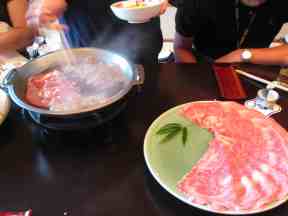

Imahan
Restaurants where I can slide my feet back and forth against tatami mats are always soothing. As is this restaurant, where I slide my feet along the smooth wooden raised floors, decorated in tradition style, down the hall to the private tatami mat room in which we are seated. The small stone garden by the window is a nice touch, and I am surprised to learn that Imahan is a chain.
Chain restaurants are definitely not just cheap fast food joints, as I have learned in Japan, and lately, I’ve been devoting some time to trying out some of Tokyo’s benchmark institutions, despite the fact that they’ve often parlayed their success into better real estate and multiple locations. Imahan is definitely one of these. Established 112 years ago, and with locations throughout the city, Imahan is not exactly off the beaten path. As someone who likes to try out little, family-owned, or funky hole-in-the-wall places, however, Imahan was certainly off my beaten path.
We started with smooth thick sesame tofu, steamed root vegetables, and cool squid salad, and continued on to a delicious sashimi plate in our set lunch. Then onto a clear stew with mushrooms, beans, carrot, and daikon, which was hearty and satisfying. But of course it was the unforgettable main event that we had come for: the meat for the sukiyaki/gyunabe was marblelized and set out in large, thinly sliced pieces. Unlike some lower market joints, two waitresses in kimono arrived to cook the sukiyaki for each end of our table. The sauce was very shallow in the pan, they always seemed to know when to add more, exactly when to turn the meat over, and just how long each vegetable needed to be cooked.
At the end, each individual bowl of raw egg was served with the sweet meat and vegetables at just the same time. The juicy meat and egg were gone in seconds, and to my surprise, our bowls were taken away. Unlike at other sukiyaki restaurants, we were given fresh egg in our bowls for each helping. So on the second go around, the ratio of egg to sauce to meat to vegetable was completely unchanged, and perfect. I had no idea sukiyaki could feel so luxurious.
Of course, as most sets do, there was some sort of dessert at the end. An ice cream? A sorbet? Was there tea? In the amazement of having eaten such phenomenal dish, I have to admit anything that followed was quite a blur.
Imahan
Suzunoya Head office Building 6F
1-20-11 Ueno Taito-ku, Tokyo
TEL: 81-3-5688-0754
(Also other locations throughout Tokyo)


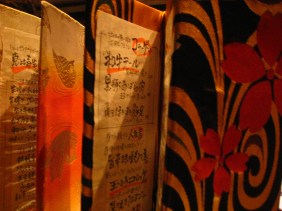 What were we drinking? Oh boy. Here is where Joumon really shines. The selection of shochu is the speciality, although the variety of choices is matched in pretty much any other drink category. Our friendly and genuine waiter led some of us to the “Kureha Royal” Umeshu, a unique plum wine made using Earl Grey tea, which was truly a revelation.


 because really, is there any other option, and really, it will be cheaper than ordering a la carte, right? (At this exact moment, you don’t realize that no matter how full you are after the dinner set, you will not be able to resist a couple mojitos, a bottle of wine or two, and maybe a fresh spicy papaya salad or delicious tender satay plate on the side
 .)
.) lemongrass, red pepper, and cilantro, a gorgeous touch to an otherwise already spectacular beef. The thinly-sliced Lump (do they mean Rump?) is medium cooked and grilled with vinegar then covered with the firey mixure which makes you wish aloud, “Dear Mango god, Please let this never end!” All your friends turn to you and decide your outburst is caused by a broken heart, pour you some more wine, and hand you a desert menu, which is really a considerate gesture considering the rice noodle soup and persimmon tatine which came with the dinner set is a bit disappointing after that main course.
 As long as you overlook the fact that every country in the world except Japan and Iceland have ratified the anti-whaling laws, you are in for one of those rare meals that can only be found in this, quite possibly the most culinarily-adventurous cities in the world. And in this particular corner of Shibuya (right next to 109), there is no attempt to hide, or even downstate the whale.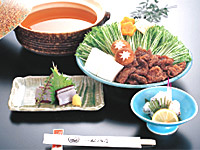

 Japan has some customs that are regarded as indelible such as not wearing shoes indoors, or thou shalt not stick chopsticks vertically into food. At the risk of sounding blasphemous to my Japanese compatriots, California may have a thing or two that it can teach Japan about creativity in the sushi world.
 The restaurant’s namesake, a crab-avocado California roll covered in generous slabs of shrimp, salmon, squid, and nobiko is succulent and unique, as is the Dragon Roll, soft warm eel embracing avocado. The ambiance is sleek and modern, and though the basic sashimi selection was fresh and well-prepared, I wouldn’t go back unless I wanted to experiment. There are myriad impeccable sushi restaurants in Tokyo, but only one where making fun of Californians is so much fun. Don’t take your Japanese grandparents… They probably won’t get it.
 How do 4 Russian-cuisine neophytes eat through 19 dishes and 24 drinks at Tokyo’s
 While independent since 1990, the former USSR republic has continued to develop and refine


 Tokyo Foodie.com